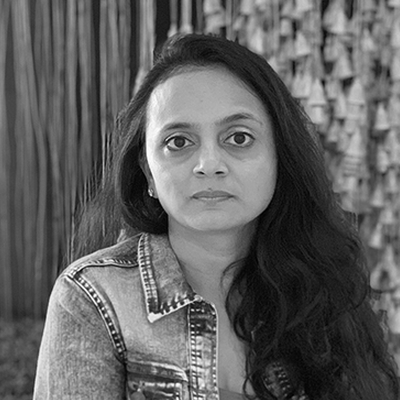
Samira Rambhia has dedicated more than 20 years to art, design, and creative education. Throughout her career, she has taught, mentored, and inspired aspiring designers while establishing and leading respected educational institutions, including Le Mark Institute, Timeless Artisans, and Sresth Education.
Passionate about nurturing creativity, Samira has helped countless students develop successful careers as fashion designers, entrepreneurs, and business owners. Her teaching philosophy combines practical industry knowledge with creative exploration, encouraging students to build both technical skills and confidence.
Alongside her work in education, Samira has been actively involved in preserving and promoting India's rich textile heritage. She has worked closely with artisan communities, supporting traditional handloom and handicraft practices while exploring innovative ways to integrate these timeless techniques into contemporary design. Her textile artworks have been exhibited at the Melbourne Museum in Australia, the National Museum in Delhi, and travelling museum exhibitions celebrating India's textile traditions.
Samira's experience extends across textile design, sustainability, social entrepreneurship, and costume design. As Vice-President of the Bhavyata Foundation, she has contributed to initiatives that support artisan livelihoods and encourage sustainable, socially responsible design practices.
Bringing together decades of teaching experience, industry knowledge, and a deep appreciation for craftsmanship, Samira is passionate about helping students develop the creative thinking, practical skills, and confidence needed to succeed in today's fashion industry. She is delighted to share her knowledge with the students at The Fashion Design Institute.
Namaste, I’m Samira Rambhia. My journey into fashion has always been driven by a love for creativity, craftsmanship, textiles, and the beautiful process of transforming an idea into something tangible.
Fashion, for me, is much more than clothing. It is a language through which we express our individuality, culture, emotions, and imagination. Over the years, my experience in design naturally evolved into a passion for teaching, allowing me to share not only technical knowledge but also the creative thought process behind good design.
I have always believed that knowledge becomes more meaningful when it is shared.
What drew me towards teaching was the opportunity to help young designers discover their own creative voice. Every student sees the world differently, and I find it incredibly rewarding to guide them from an initial thought or sketch to a design they can confidently call their own.
Teaching also keeps me constantly inspired. Students bring fresh perspectives, unexpected ideas, and an energy that encourages me to keep learning alongside them.
A good fashion designer needs a combination of creativity, observation, curiosity, technical understanding, and perseverance.
Creativity gives you ideas, but discipline allows you to bring those ideas to life. Understanding fabrics, silhouettes, colour, construction, proportion, and detailing is essential, but equally important is developing an eye for the world around you.
I also encourage students to be patient with the creative process. Not every idea works immediately. Sometimes the most interesting designs emerge through experimentation, mistakes, refinement, and trying again.
One of the projects closest to my heart has been my work for Sutr Santati, a travelling exhibition celebrating India’s rich textile heritage. I had the opportunity to develop seven textiles with my students, exploring traditional dyeing techniques and reinterpreting them through a contemporary design lens.
I am also deeply inspired by Indian festivals, traditions and deities. Their colours, symbolism, rituals and stories allow me to explore the connection between textiles, culture and spirituality.
For me, the most fulfilling projects are those that tell a story, preserve tradition, and create a meaningful connection through contemporary design.
My teaching philosophy is simple: guide the student, but never design for the student.
I believe every learner should develop an individual point of view rather than simply follow trends or imitate someone else's aesthetic. My role is to provide them with the right technical foundation, encourage exploration, question their choices when necessary, and help them understand why a design works.
I like my classroom to be a space where students feel comfortable experimenting. There should be room to sketch freely, make mistakes, ask questions, change direction, and discover something unexpected.
I focus on helping students understand the complete journey of design rather than viewing each skill in isolation.
This includes developing concepts and inspiration, research, mood boards, colour and fabric understanding, fashion illustration, silhouettes, garment details, design development, presentation, and most importantly, learning how to translate an idea into a cohesive visual story.
Alongside technical skills, I encourage students to strengthen their observation, originality, confidence, presentation skills, and design thinking.
I want students to eventually reach a stage where they do not constantly ask, “Is this correct?” but instead confidently explain, “This is the reason I made this design choice.”
I would describe my approach to design as thoughtful, expressive, and detail-oriented.
Inspiration can come from almost anywhere — nature, architecture, Indian textiles, traditional crafts, art, history, travel, everyday people, or even a particular colour or texture that catches my attention.
I particularly enjoy the dialogue between tradition and contemporary design. There is so much beauty and knowledge within craft traditions, and I find it exciting when those influences can be interpreted in a fresh and relevant way.
My biggest influences are designers and textile practitioners who show that tradition and innovation can coexist. Some of the most meaningful work in fashion, to me, comes from people who have looked deeply into their own cultural heritage, worked alongside artisan communities, and brought traditional textile knowledge into a contemporary context.
I am inspired by Laduma Ngxokolo and Alphadi for their work celebrating African culture and craftsmanship. From Asia, I admire Reiko Sudo for her innovative approach to Japanese textiles and Didiet Maulana for keeping Indonesian ikat relevant in contemporary fashion. I also admire Gaurang Shah, whose contemporary work is deeply rooted in Indian handloom traditions.
What connects all these practitioners is their ability to treat tradition as a living source of knowledge—something to preserve, reinterpret, and carry forward through contemporary fashion.
The transformation.
There is a very special moment when a student who initially says, “I don’t think I can do this,” begins presenting their own ideas with confidence.
Seeing that growth — from hesitation to curiosity, from curiosity to skill, and from skill to self-expression — is probably the most fulfilling part of teaching.
I also love that no two students are the same. Each one brings a different personality and perspective into the classroom, which means teaching fashion is never repetitive. Every batch becomes a new creative journey.
Observe everything. Sketch often. Stay curious. And do not be afraid of making mistakes.
Do not enter fashion believing that you need to immediately discover a signature style. Give yourself time to explore. Study fabrics, craftsmanship, art, people, culture, construction, and the world around you.
Build strong fundamentals, but also protect your individuality.
Most importantly, do not compare the beginning of your journey with someone else’s finished work. Fashion design requires patience, practice, openness, and a willingness to evolve.
Your strongest work will eventually come when you stop trying to design like everyone else and begin discovering what you genuinely want to say through design.
Developing a cohesive collection felt like a giant leap forward. Not only did I learn the technical aspects, but I also discovered my unique voice, expressed through the garments I designed.



©2026 The Fashion Design Institute. All rights reserved.


 Australia
  Canada
  Hong Kong
  India
India  Ireland
  Malaysia
  New Zealand
  Philippines
  Qatar
Qatar  Singapore
  South Africa
  United Kingdom
  United States